Instagram Followers vs Following: Which Has Better Leads?
A followers list is made of actions taken toward someone else. A following list is made of actions your prospect took. That difference decides which one deserves your outreach time — and it is not the one most guides recommend.
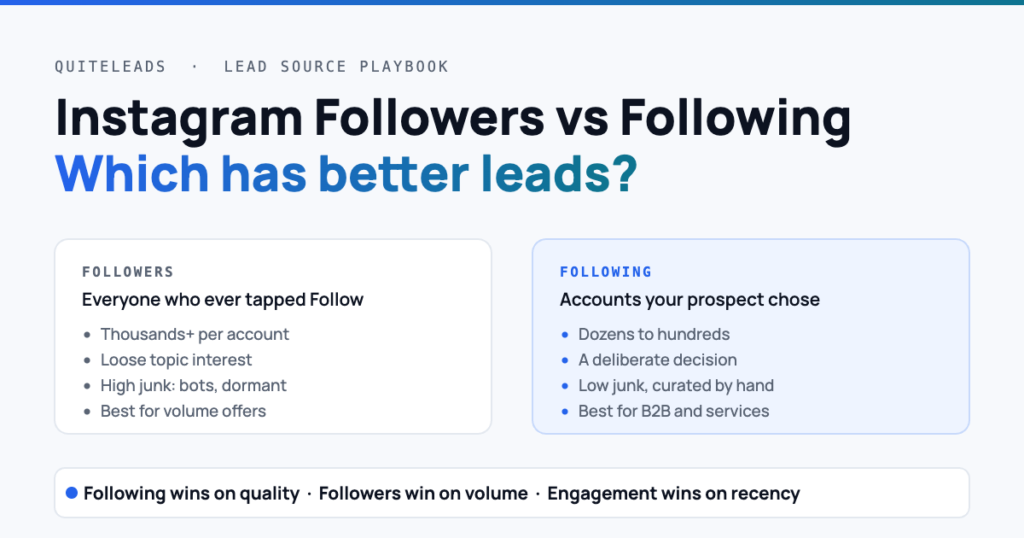
Instagram followers vs following: which list produces better leads.
Short answer: for B2B and service businesses, a following list produces better leads. Instagram followers vs following comes down to one thing — who took the action. A follow is a decision your prospect made; a follower is a decision someone made about an account that is not yours.
Key takeaways
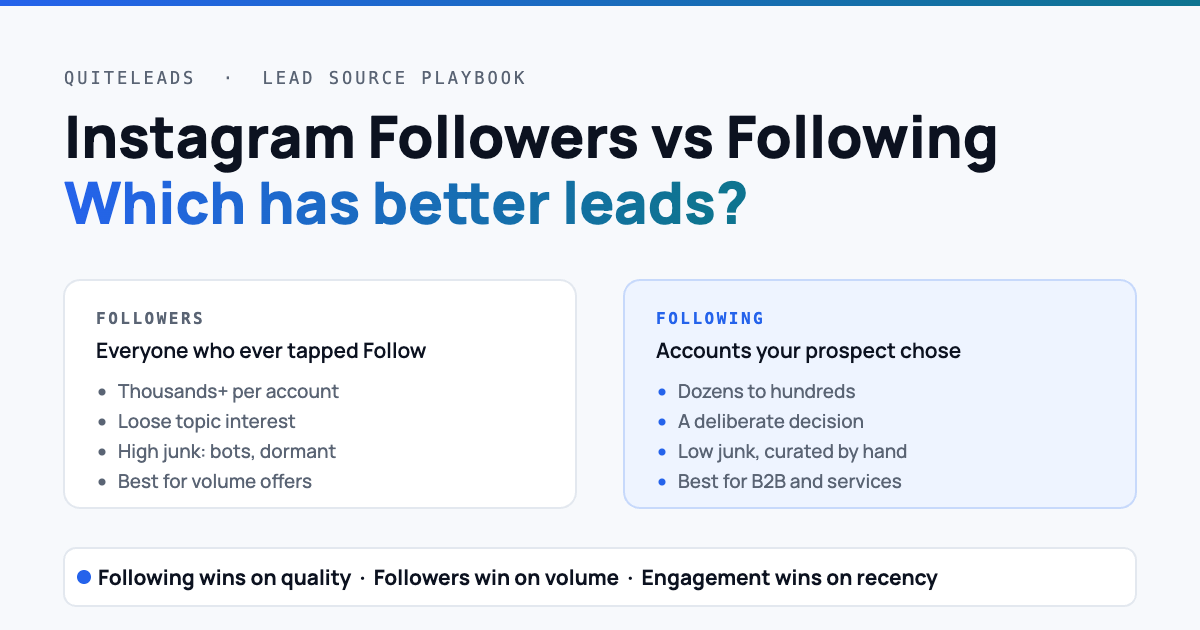
The Instagram followers vs following question has three answers, depending on what you sell:
- Following lists win on quality. Smaller, deliberate, low junk rate.
- Followers lists win on volume. Bigger, looser, full of bots and dormant accounts.
- Post likers and commenters win on recency. They are active right now.
- Filter on bio signals before messaging anyone, whichever list you start from.
Table of contents
What is the difference between followers and following on Instagram?
An account’s followers are everyone who has ever tapped Follow on it. Its following list is the set of accounts that person or business deliberately chose to follow.
Nobody follows 300 accounts by accident. A following list is closer to a bookmark folder than an audience — every entry was a decision. A followers list, by contrast, accumulates passively: bots, giveaway traffic, and people who tapped Follow in 2021 and have not opened the app since.
That asymmetry is the whole of the Instagram followers vs following argument. One list records what a crowd did to somebody else. The other records what one specific person chose. When you are deciding who deserves a message, the second is worth far more than the first.
Why a following list produces better leads
Two plays turn a following list into pipeline.
- Mine your ideal customer’s following list. If a wedding photographer you would love to work with follows forty other wedding photographers, you have just found forty more of exactly the right prospect — pre-qualified by someone who knows the industry better than you do.
- Read what your target follows to learn what they buy. The tools, agencies and vendors in someone’s following list show what they already spend money on, which is the fastest way to judge whether they will spend money on you.
One ratio is worth internalising. An account with 40,000 followers and 300 following is a broadcaster — its followers are the asset. An account with 800 followers and 4,000 following is usually a consumer or a growth-hack account, and neither list is worth much. Business accounts with a few thousand followers and a curated few hundred following are where the good following lists live.
This is also why Instagram followers vs following is not a fair fight on raw numbers. A followers list can be a hundred times larger and still contain fewer real buyers, because size and intent are measuring completely different things.
How to pick your five seed accounts
A following list is only as good as the account you take it from. Picking seeds badly is the most common way people conclude that Instagram followers vs following made no difference for them — they mined the wrong accounts.
Good seed accounts share four traits:
- They look like your best existing customer, not like your dream logo. The company you already serve well is the honest template.
- They are operators, not media brands. A working photographer follows other working photographers. A magazine about photography follows advertisers.
- Their following count sits somewhere between roughly 150 and 1,500. Below that the list is too thin to be useful; far above it and you are looking at someone who follows back indiscriminately.
- They post about their actual work. An account that only reposts memes is not curating a professional network.
Five seeds is the right starting number. Fewer and you are betting everything on one person’s taste; many more and you spend your morning collecting instead of selling. Five accounts at a few hundred following each gives you a working pool of one to two thousand names before deduplication, which is a week of sensible outreach.
The overlap between seeds is a signal in itself. An account that appears in three of your five following lists is, almost by definition, central to that niche — either a prospect worth prioritising or a competitor worth studying.
When a followers list is still the right call
Instagram followers vs following is not a universal ruling. Followers win on volume, and on topic-level relevance. If you are selling something broad to a consumer audience, you need a lot of names and only loose targeting — and ten thousand names at a two percent hit rate still produces meetings. It is a volume play, and it costs you in time rather than in precision.
Followers lists also make sense when the seed account is the market. If a single directory, event or trade publication is where your entire industry gathers, its followers are effectively an industry list, and no following list will match that coverage.
Instagram followers vs following, side by side
| Followers | Following | |
|---|---|---|
| Typical size | Thousands or more | Dozens to a few hundred |
| Who acted | Them, toward someone else | Your prospect, deliberately |
| Signal strength | Loose topic interest | A considered choice |
| Junk rate | High: bots, dormant, giveaway | Low |
| Best for | Volume outreach, consumer offers | B2B, services, high-ticket |
| Time per booked call | High | Low |
The third list most people skip
Both lists share one weakness: they are historical. A follow from three years ago still sits in that list today, next to the account that has since gone quiet.
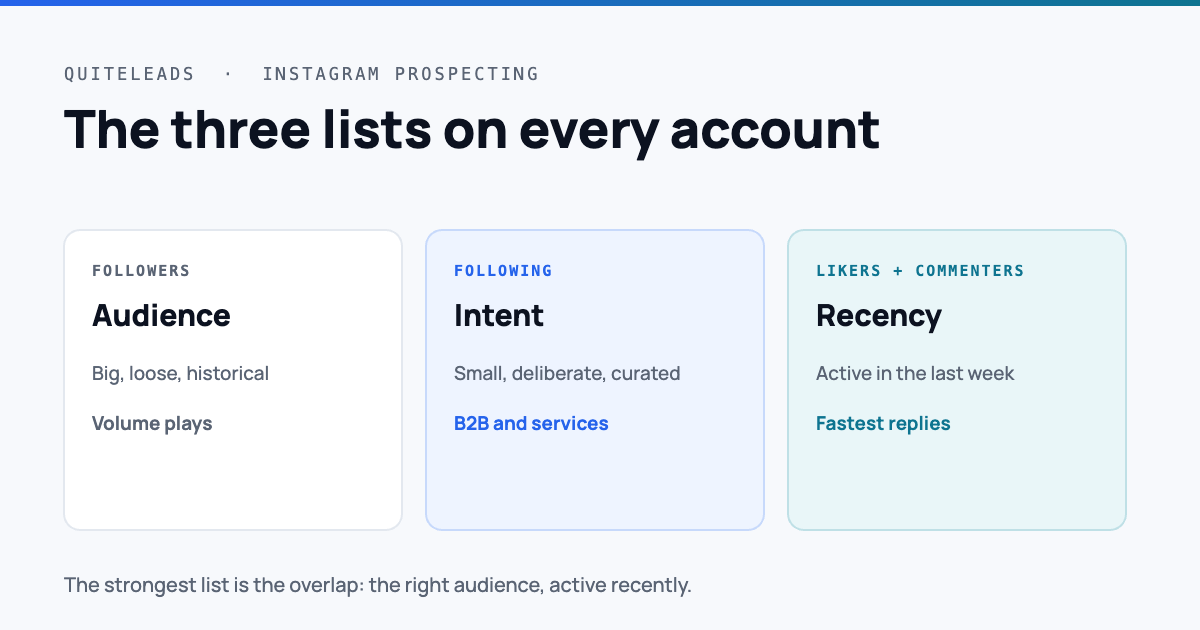
The people who liked or commented on a post from last week are active right now. That is a different axis — not interest, but recency — and it is usually the one that decides whether your message gets seen at all. The strongest list is the overlap: someone who follows the right account and engaged with something in the last month.
Treat engagement as a filter rather than a source. Build the pool from the Instagram followers vs following decision above, then use recent likers and commenters to decide who to contact first.
What each list costs you in time
Score the two lists on effort rather than size and the Instagram followers vs following gap widens further.
Say a followers list converts at two percent and a following list at eight — conservative figures for a well-chosen niche. To book ten calls you need roughly 500 messages from the followers list against roughly 125 from the following list. At a safe sending pace, that is the difference between a fortnight of daily outreach and about three days.
The gap compounds, because a smaller list is also a list you can personalise. Nobody writes a specific opening line for 500 strangers. Most people will write one for 125.
How to filter either list before you message
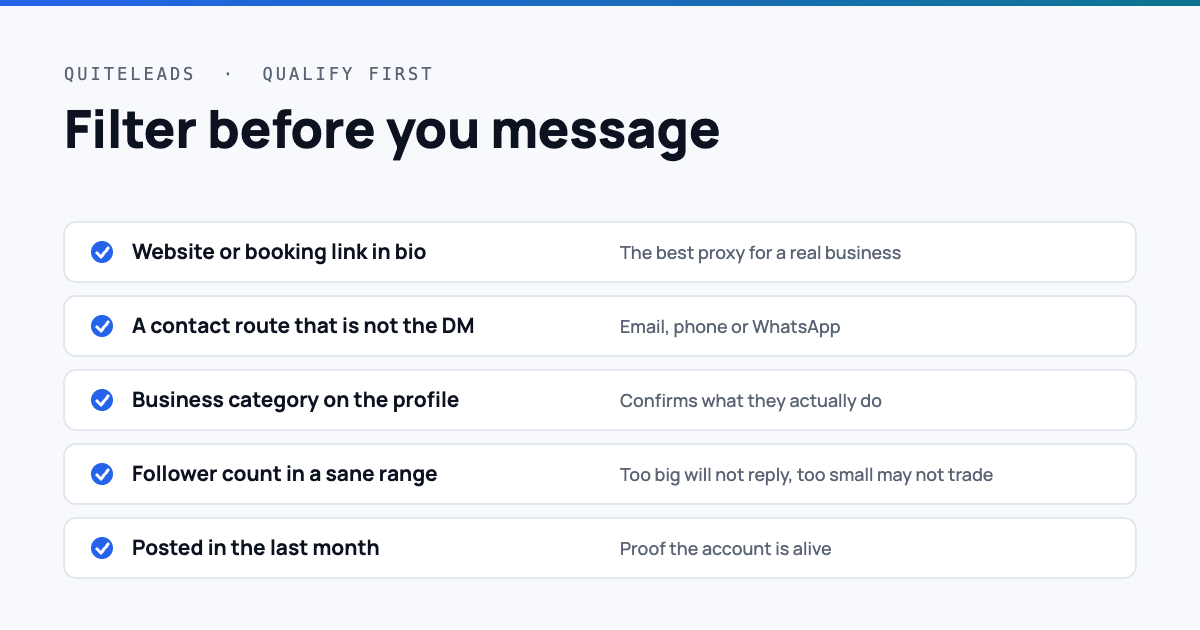
- A website or booking link in the bio — the single best proxy for “this is a business”
- A contact method that is not the DM: an email address, a phone number, a WhatsApp link
- A business category on the profile
- A follower count inside a sane range — very large accounts will not read a DM, very small ones may not be trading yet
- Posted something in the last month
Applied honestly, these signals usually remove half a followers list and perhaps a fifth of a following list. That difference in survival rate is the Instagram followers vs following comparison expressed as work you no longer have to do.
How to collect Instagram followers and following lists
The thinking above is free. The tedium is the bottleneck: opening profiles one at a time, copying handles into a sheet, clicking through to websites to find an email, and losing track of who you already contacted.
That is the part QuiteLeads handles. It is a Chrome extension, so it works on the Instagram page you already have open — no login handed over and no cloud queue. You can collect from followers, following, hashtags, post likers and post commenters, so you can run the Instagram followers vs following comparison on your own niche instead of taking my word for it.
Emails and phone numbers are read from each prospect’s own site and land attached to the handle, and people you have already collected are skipped automatically. Every list sits in one dashboard alongside your leads from Google Maps, LinkedIn, TikTok, Facebook and the rest. Export to CSV or JSON whenever you want, or message straight from the list.
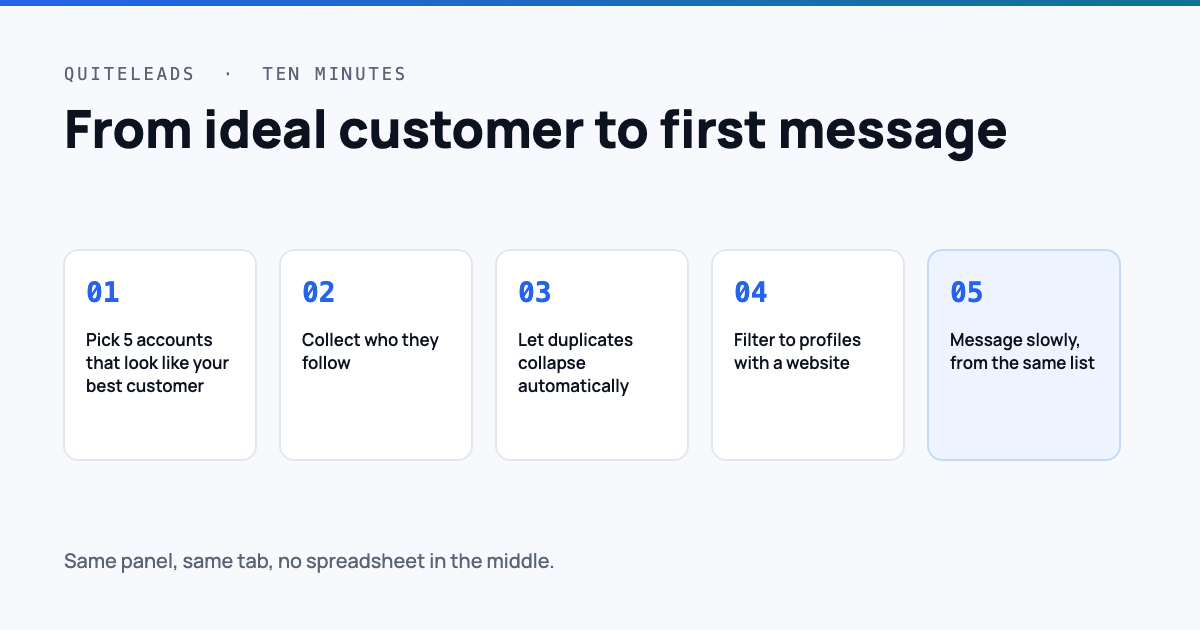
Practically, the workflow this article argues for takes about ten minutes: pull the following lists of five ideal-customer accounts, let the duplicates collapse, filter to the profiles with a website, and start there.
What to say once you have the list
A following list changes the opening line, which is the real reason it outperforms. You know something specific and true: this person chose to follow that account. That is a reason to be in their inbox.
Three rules keep the advantage:
- Reference the shared context, not the scrape. Mention the niche, the tool they use, or the work on their profile — never how you built the list.
- Ask one small question. The goal of the first message is a reply, not a sale.
- Send where they answer. If the bio publishes an email, the email will usually outperform a DM, because it lands somewhere they check on purpose.
A worked example
Say you sell branding to independent coffee roasters. The followers route means finding the biggest speciality-coffee account you can and taking its audience: perhaps 60,000 names, mostly people who simply like coffee. Home brewers, students, competitors, a decent number of bots. Filter it on the bio signals and maybe 8,000 survive, of which a small fraction actually own a roastery.
The following route means picking five roasteries whose branding you admire and taking the accounts they follow. Each list runs to a few hundred: their wholesale customers, their green-bean importers, their packaging suppliers, the cafes that stock them, and a dozen other roasters. Deduplicated, that is perhaps 900 names — and almost every one of them is a business in coffee.
The second list is a fifteenth of the size and will book more work. That is the Instagram followers vs following trade-off in a single niche, and it is why the smaller number is the better one. It is also repeatable: the packaging suppliers in that list are a second market, and the cafes are a third.
Run the same exercise in your own category before you accept the general answer. Instagram followers vs following resolves differently for a consumer app than it does for a service business, and one afternoon of testing beats any article, this one included.
Mistakes that waste a good list
- Mining a celebrity account. A following list from an account with two million followers is a list of brands and friends, not buyers.
- Skipping deduplication. Message the same person from two seed lists and you have taught them you are automated.
- Messaging in the order collected. Sort by the filter signals first, or you spend your best hours on your worst prospects.
- Treating the list as permanent. Profiles go quiet, businesses close. A list older than a quarter deserves a refresh before a second pass.
- Judging Instagram followers vs following on one run. Two seed accounts is a sample too small to conclude anything.
How this compares on other platforms
The logic behind Instagram followers vs following transfers, but the balance shifts by network.
- LinkedIn — connections are mutual, so the intent signal is weaker, but job titles do the qualifying that bios do on Instagram.
- X — following lists are cheap to build and genuinely curated; the same rules apply almost unchanged.
- TikTok — following lists are noisier because the algorithm, not the user, drives most discovery. Commenters are the better source.
- Facebook — groups and page followers behave like a followers list: broad, and best used for volume.
Run the Instagram followers vs following test on your own niche first. Whichever side wins there is usually the side that wins on the other networks too, because it tells you whether your buyer is found by intent or by volume.
What to measure
Track four numbers per source, and the Instagram followers vs following debate stops being a matter of opinion on your account:
- Qualified rate — how many survived the bio filters.
- Reply rate — replies divided by messages sent.
- Calls booked per hundred messages — the number that actually pays you.
- Minutes per booked call — collection plus filtering plus messaging.
Run five seed accounts from each side, hold the message constant, and read the last two numbers after a fortnight. Your niche may disagree with this article, and your numbers outrank my opinion.
Is this safe to do?
Instagram is the strictest network out there, and no tool can promise you will not get restricted — every network decides that for itself, and a new account pushed hard is the most likely to go. The rules that apply to your account are set out in the Instagram Help Center, and they change.
This is another argument for following lists over followers lists. A few hundred well-chosen prospects messaged slowly is a safer pattern than a few thousand messaged fast, and it usually books more calls anyway. Keep the gaps long, start small, and stop for the day if something gets blocked.
Frequently asked questions
Is it better to target Instagram followers or following?
For B2B and service businesses, following lists are better: they are smaller, deliberately chosen and carry far less junk. Followers lists are better when you need volume for a broad consumer offer and can accept a lower hit rate.
How many leads can you get from an Instagram following list?
Usually dozens to a few hundred per account, compared with thousands from a followers list. The number is smaller on purpose – every entry was a deliberate choice, so a higher share of them are real prospects.
Are Instagram post likers better leads than followers?
They are fresher. Followers and following lists are historical, while someone who liked a post last week is demonstrably active. The strongest list is the overlap: the right audience plus recent activity.
What is the follower to following ratio worth watching?
High followers with low following means a broadcaster, so its followers are the asset. Low followers with very high following usually signals a consumer or growth-hack account worth skipping. Business accounts with a curated few hundred following have the best lists.
How many seed accounts should you mine?
Five is a sensible start. That gives a pool of one to two thousand names before deduplication, which is about a week of safe outreach, and it is enough of a sample to tell you which side of the comparison wins in your niche.
The verdict on Instagram followers vs following
That is Instagram followers vs following in one line. Following wins on quality. Followers win on volume. Engagement wins on recency. If you are selling anything with a real price tag, start with following lists — they are smaller, and that is the point.
Get QuiteLeads and test both lists on your own niche this week, or read more lead source playbooks.